

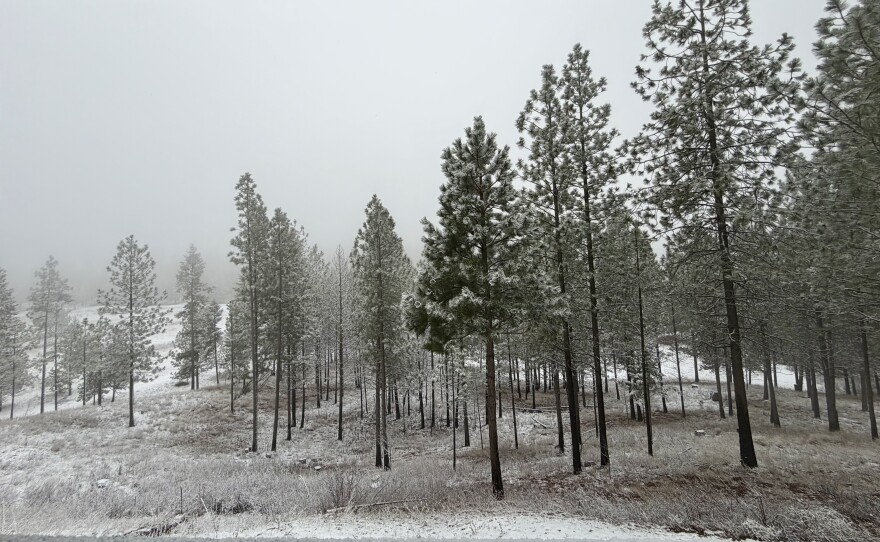

CHEWELAH – In 1992, Lynn and Becky Miner bought 100 acres of land with plans to build a log home and start a tree farm – despite not knowing anything about forestry.
Just last month, they donated their 100-acre tree farm to Washington State University Extension Forestry.
“As corny as it sounds, Becky and I both have the attitude that we have a responsibility to leave the world a better place than what we found it, and this was our way to do that,” Lynn Miner said.
Originally from Albuquerque, New Mexico, the Miners began working on what they call Casa Becca del Norté, or Becky’s House of the North, after realizing the land had been poorly mismanaged. Over the next 30 years, they planted more than 11,000 ponderosa pines and western larch trees. They also installed more than 700 nest boxes, slowly bringing life back to the forest. Today, more than 80 species of birds and small animals call the tree farm home.
“We took a really poorly managed forest and turned it into a work of art,” Lynn Miner said.
Before their purchase, Lynn Miner said the land had been homesteaded in the 1880s and was shaped by generations of poor logging practices, which was evident once they began working on the forest.
“They cut down all the really good trees and left all the bad ones, so there was bad genetics,” Lynn Miner said. “Trees have genetics just like animals do, and it was in really bad shape. We didn’t know that. We just thought it was pretty.”
Becky Miner said she remembered the silence most of all. Birds were noticeably absent, and the only thing they would hear were coyotes. That’s when she reached out to Cornell University and learned how to make the nest boxes.
“Now people come here, and it’s like a cacophony of birds,” Becky Miner said.
The Miners said they subsequently reached out to multiple other agencies, including the Department of Resources, the National Resource Conservation Service and Stevens County Conservation District, to learn how to best grow their tree farm.
Lynn Miner added they had mentorship from Bob Playfair, who was named the 2005 Washington state Outstanding Tree Farmer of the Year.
“He taught us a lot of things about how to grow trees, how to plant trees, how to select trees for making things more healthy, and how to improve wildlife,” Lynn Miner said.
During the busiest months, especially in the spring, the Miners devoted as many as 80 hours a week to the tree farm. On average, Lynn Miner said they spent at least 20 hours a week over 30 years reshaping the forest, all on top of their full-time jobs.
“In the spring it was really intense, because that’s when we planted the trees, and then towards the fall, when we were pruning and thinning,” Becky Miner said.
But after 25 years of hands-on work, the question became what would happen to the forest.
Lynn Miner said selling it was never an option. And with one child living in a group home in Spokane and another living out of state with no interest in managing a tree farm, the Miners began exploring philanthropic options. That’s when they decided to donate it to an organization that would preserve it as a working forest.
“That’s how we came up with WSU,” Lynn Miner said.
Andy Perleberg, WSU’s state extension forester, said he has known and worked alongside the Miners since 2005. When he learned the tree farm would be donated, Perleberg said he knew it would be crucial for future forest health improvement research.
“This is really a special gift,” Perleberg said.
He said small-scale forest owners face challenges in managing their land due to operational capacity, access and engineering considerations, which make it hard for owners to maintain a healthy forest ecosystem.
“So what my vision is is that this forest land can be used to help develop these solutions, these operational opportunities and create a workforce that can do the work in order to help the multitudes of people who own forest land in Eastern Washington,” Perleberg said.
With wildfire hazards and forest health as the top concerns in northeast Washington, he hopes the tree farm will give students and visitors hands-on demonstrations in forest management, such as thinning, pruning and proper debris disposal to reduce wildfire risk and improve forest health.
Learning about tree spacing and density, he added, can also prevent overstocked stands that stress water resources and make trees more susceptible to bark beetles. Root diseases, common in Eastern Washington, are another inevitable concern, making proper management even more important, he said.
However, Perleberg emphasized the land isn’t exclusive and is meant to benefit the wider community.
“If anybody wants to use the property, they can just reach out and we’ll figure out how we can serve their needs,” he said.
Lynn Miner said the university has already had students use the tree farm for entomology studies, forestry health research and outdoor recreation projects. WSU’s Law Enforcement Division is also looking to use it to teach winter survival skills.
“It’s going to be utilized, and that’s what we want,” Lynn Miner said.
