

David Welna
David Welna is NPR's national security correspondent.
Having previously covered Congress over a 13-year period starting in 2001, Welna reported extensively on matters related to national security. He covered the debates on Capitol Hill over authorizing the use of military force prior to the wars in Afghanistan and Iraq, as well as the expansion of government surveillance practices arising from Congress' approval of the USA PATRIOT Act. Welna reported on congressional probes into the use of torture by U.S. officials interrogating terrorism suspects. He also traveled with Defense Secretary Chuck Hagel to Afghanistan on the Pentagon chief's first overseas trip in that post.
As a national security correspondent, Welna has continued covering the overseas travel of Pentagon chiefs who've succeeded Hagel. He has also made regular trips to the U.S. naval base in Guantanamo Bay, Cuba, to provide ongoing coverage of the detention there of alleged "foreign enemy combatants" and the slow-moving prosecution of some of them in an episodically-convened war court. In Washington, he continues to cover national security-related issues being considered by Congress.
In mid-1998, after 16 years of reporting from abroad for NPR, Welna joined NPR's Chicago bureau. During that posting, he reported on a wide range of issues: changes in Midwestern agriculture that threaten the survival of small farms, the personal impact of foreign conflicts and economic crises in the heartland, and efforts to improve public education. His background in Latin America informed his coverage of the saga of Elian Gonzalez both in Miami and in Cuba.
Welna first filed stories for NPR as a freelancer in 1982, based in Buenos Aires. From there, and subsequently from Rio de Janeiro, he covered events throughout South America. In 1995, Welna became the chief of NPR's Mexico bureau.
Additionally, he has reported for the Canadian Broadcasting Corporation, The Financial Times, and The Times of London. Welna's photography has appeared in Esquire, The New York Times, The Paris Review, and The Philadelphia Inquirer.
Covering a wide range of stories in Latin America, Welna chronicled the wrenching 1985 trial of Argentina's former military leaders who presided over the disappearance of tens of thousands of suspected dissidents. In Brazil, he visited a town in Sao Paulo state called Americana where former slaveholders from America relocated after the Civil War. Welna covered the 1992 United Nations Earth Summit in Rio de Janeiro, the deforestation of the Amazon rainforest, the mass exodus of Cubans who fled the island on rafts in 1994, the Zapatista uprising in Chiapas, Mexico, and the U.S. intervention in Haiti to restore Jean Bertrand Aristide to Haiti's presidency.
Welna was honored with the 2011 Everett McKinley Dirksen Award for Distinguished Reporting of Congress, given by the National Press Foundation. In 1995, he was awarded an Overseas Press Club award for his coverage of Haiti. During that same year he was chosen by the Latin American Studies Association to receive their annual award for distinguished coverage of Latin America. Welna was awarded a 1997 Nieman Fellowship at Harvard University. In 2002, Welna was elected by his colleagues to a two-year term as a member of the Executive Committee of the Congressional Radio-Television Correspondents' Galleries.
A native of Minnesota, Welna graduated magna cum laude from Carleton College in Northfield, Minnesota, with a Bachelor of Arts degree and distinction in Latin American Studies. He was subsequently a Thomas J. Watson Foundation fellow. He speaks fluent Spanish, French, and Portuguese.
-
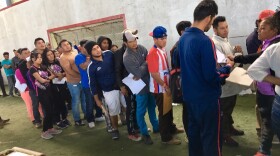 The Mexican government, faced with thousands of destitute migrants on their side of the U.S.-Mexico border, is inviting them to apply for jobs in Tijuana.
 -
 In Tijuana, thousands of migrants are waiting for their turn for an interview with U.S. immigration officials. Most are camped out in a squalid sports complex that's been turned into a shelter.
 -
 Asked on Thursday if active duty soldiers being sent to the border with Mexico would fire on migrants who throw rocks, Trump said he hoped not. On Friday, he said soldiers would arrest them instead.
 -
Active duty troops have begun moving to bases in the southwest, preparing for deployment along the U.S.-Mexico border.
-
President Trump's declared intention to pull out of the Intermediate Nuclear Forces treaty raises the odds of a new nuclear arms race and the repudiation of arms control as a check against nuclear Armageddon.
-
The Pentagon has just been authorized to make changes to its officer promotion policy that would, among other actions, make it possible to stay on at one's rank rather than face up-or-out promotion peril.
-
A year ago, President Trump said his original instinct was to pull out of Afghanistan. But he chose to stay. NPR looks at what's changed since then in Afghanistan — and what hasn't.
-
Hours after President Trump signed into law the annual defense policy bill, he — like his recent predecessors — issued a signing statement challenging the constitutionality of 52 provisions in the bill.
-
 The 2,500-page National Defense Authorization Act, which tells the Pentagon how to spend its budget, is headed to President Trump's desk for signature. A look at its key provisions.
 -
President Trump has claimed his summit with North Korean leader Kim Jong Un has led that nation to begin the process of denuclearization and removed its threat to the United States. A fact check.


