From Spokane Public Radio, it’s SPR News Today.
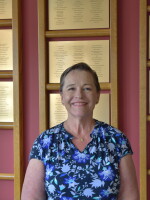
I’m Lisa Leinberger. It’s Thursday, November 5, 2026.
We have a look at how some Democrat candidates in Spokane County are excited about the results–even though they are still behind.
Governor Bob Ferguson says a too-large majority may not be such a good thing in politics
Idaho’s HJR4 is failing–we’ll talk about what that means
And SPR’s Ember Braun chats with a man who is bicycling through 48 of the United States.
Those stories and more, coming up on SPR News Today.
Eastern Washington Democrats may not have seen a “blue wave” on the same scale as the one that swept the nation … but many did make inroads in historically red districts. And *some* races are still too close to call.
In Washington’s 4th legislative district, incumbent Republican Rob Chase leads Democrat Rob Tupper by nearly ten percentage points.
For Tupper, that’s…exciting news.
ROB TUPPER: Will that turn? Probably not, but if it does it'd be a miracle, and it's also a great big showing for the Democratic wave in the fourth legislative district.
In 2024, Chase’s Democratic challenger lost with 36 percent of the vote. In 2022, no Democrats made it to the general election. And in 2020, the Democratic candidate again lost by almost 30 percentage points.
So far, Tupper has drawn over 45 percent of the vote.
RT: And I'm just looking forward to two years from now when myself or someone even better will be running this race.
Tupper isn’t the only Democrat performing better than expected. Early results in the 6th district, which includes Fairchild Air Force Base, show third-time candidate Michaela Kelso with about 48 percent of the vote.
MICHAELA KELSO: So, considering that in ’22, I got 39.4% — no, in ’24, I got 39.4%, and in ’22, I got 38-something percent, it's a 10-point gain, and it's significant.
Kelso, a Democrat, is behind Republican opponent Alan Nolan by about three points.
One of Election Night’s most high-profile races is a national one — Washington’s Fifth Congressional District, which spans most of Eastern Washington. Democratic challenger Carmela Conroy trails Republican incumbent Michael Baumgartner by less than a percentage point.
CARMELA CONROY: People are really hurting, and we have spoken very clearly that our incumbent representative has not been looking after our interests in this district. That's what I'm hoping to do, and that message is out there, but it's too close to call.
Conroy previously ran against Baumgartner in 2024. She lost that election by more than 20 percentage points.
I’m Audrey Nelson, reporting.
______________________________________________
One of the Spokane County sheriff’s deputies shot near Spangle Tuesday afternoon has died.
The sheriff’s office said yesterday that the deputy died overnight. The other deputy is reportedly on life support and is not expected to survive.
The sheriff’s office has not yet identified either victim.
This brings the total number of people killed during yesterday’s shooting to four.
County Sheriff John Nowels told reporters Tuesday night that the initial call from the scene warned about a shooting and domestic violence situation.
Nowels says members of his department’s SWAT team approached a home where the suspect was believed to be. When they tried to enter, two deputies were shot and wounded.
According to Nowels, the gunman was also among those killed.
The investigation is being led by the Spokane Police Department and Washington State Patrol.
______________________________________________
Unofficial results for Idaho’s House Joint Resolution 4 show the amendment failing, by roughly 200,000 votes as of noon Wednesday.
This is the measure that would give only the state legislature the power to legalize and regulate marijuana, narcotics and other psychoactive substances.
Luke Mayville is the co-founder of Reclaim Idaho, which promotes Idahoans' right of access to the ballot initiative process.
MAYVILLE: “Idahoans really saw through this scheme for what it was. It was never really about drugs. It was always about power and about the right of Idaho voters to make their voice heard through the ballot initiative process.”
Esther Loera was voting in Coeur d’Alene on Election Day. She says she’s in support of HJR-4.
LOERA: “I think they would make a better decision to keep it out and not make it legal.”
The Idaho secretary of state’s office says results are unofficial until the count is complete.
______________________________________________
Spokane city and county partnered to apply for a federal grant that would help improve transportation infrastructure in the Indian Trail and Five Mile neighborhoods.
Currently, both areas rely on only a few arterial streets. That posed a challenge as residents fled the Spokane Complex Wildfires.
The $1.4 million PROTECT (Promoting Resilient Operations for Transformative, Efficient, and Cost-saving Transportation) grant is administered by the U.S. Department of Transportation. It would help the city and county conduct a vulnerability assessment and identify emergency transportation routes in and out of the neighborhoods.
The grant would also fund an evacuation transportation communication plan.
The award is expected to be announced by the end of the year.
______________________________________________
At a post-election press conference yesterday, Governor Bob Ferguson said the Democrats could have a supermajority in the State House this next legislative session.
Although he doesn’t predict that for the State Senate, he acknowledges there will be a majority.
With legislative numbers favoring the Democrats so heavily, Ferguson issued a warning.
FERGUSON: I do think that when one party has control of all three branches, that party has to be vigilant to make sure they’re being responsive to the people, right? And I think we’ve seen at the Federal level, when Republicans control the White House and the Senate and the House, some pretty disastrous policies that led to that tsunami yesterday, right?
He says like always, voters will have to hold the state government accountable.
______________________________________________
For more than two decades, physician-scientist Andrew Trister has studied how artificial intelligence can be used in medicine and research.
He’s in Spokane this week as part of a partnership between Gonzaga University and the University of Washington School of Medicine.
Trister says he’s excited about A-I’s potential — specifically when it comes to sifting through medical knowledge.
ANDREW TRISTER: Staying on top of literature is almost a superhuman task to begin with. We publish more in medical literature in a given week than we could read in a year.
But Trister warned that before leaning fully into A-I tools, healthcare providers need to focus on building trust.
ANDREW TRISTER: The key is that we have to ensure that we prevent algorithmic bias and that we keep vulnerable people from being left behind.
Trister will speak at Gonzaga’s Hemmingson Center tonight [THURS] at 6 P-M.
______________________________________________
And a correction to a story that aired yesterday on SPR News Today. That’s about the Washington state initiative that seeks to ban transgender athletes from girls’ sports.
The ACLU says it would fight the measure in court if it passes. The story erroneously attributed that comment to Washington’s Attorney General.
______________________________________________
Jack Thompson is a world-record endurance athlete from Australia, currently making his way through the Inland Northwest. It’s a part of his 60-day cycling journey through all 48 mainland U-S states. S-P-R’s Ember Braun chats with Thompson about the story behind his ride and how mental health is at the center of his mission.
Ember Braun: You’re going on a 10,000+ mile journey by bike, so I’d imagine that’s not the easiest ride. Why are you doing this?
Jack Thompson: I’ve built a career out of doing these long distance cycling projects. My background is, I spent time in rehabilitation with substance abuse issues in my early 20s. I use the long-distance cycling challenges as a way of connecting with people, sharing my story and also learning about how other people use the bike to overcome their own challenges in life, but also to explore what community means to people. I thought, now in America, what a great time to come and explore the country and see how different communities and the different states band together in times of hardship.
EB: And why come over here and do this?
JT: Yeah, so I’m from Australia. I think it’s interesting because if I open the Australian news, a lot of the news there is dominated by American politics and the sort of clickbait kind of extremes that don’t necessarily reflect what America really is. I was intrigued to come and explore America and actually see it all and form my own opinion and share what I’ve seen with others to try and help shape a more accurate representation of what America is.
EB: Why highlight physical activity and how does that intersect with mental health?
JT: I think for a lot of people physical activity is a fantastic way to kind of regulate their mental health. I’m a big advocate for using exercise as a form of therapy, not that I’m a doctor or a psychologist. But I like to use the term meditation in motion. When I’m on a bike, and I’m exercising, I find it’s one of the few times that my mind is truly still. I think highlighting that to others and sharing that mindset with others has been interesting.
But at the same time, what’s also been interesting is learning that not everybody enjoys exercise. There’s other communities, there’s other activities that people use to regulate their mental health when times are tough. It’s been interesting learning about that, what works for others. Because, like I said, the bike was great for me, but the bike's not for everyone.
EB: Yeah, just throughout this whole time, talking to so many people, what do you think is maybe the biggest thing that you've learned about how people cope or what people should do if they're struggling?
JT: What I've learned, and what I've taken from the interactions that I've had along the way, is I think everybody at the moment is struggling with their own challenges.
And not just in America, it's around the world, everybody has their own hardships. But what's been really powerful is that what most people speak to is the power of having a community or having a group of people around them that they can communicate with when times are tough.
What’s really been interesting is learning about those different communities, from the homeless community, to the art community, the music community, to the cycling community to, you know, kids at school.
EB: And I guess a little bit more about what your journey has been like.
What does every day look like for you?
JT: They're long days. We're on the bike typically from about 6 a.m. to 4:35 p.m. So I'm riding roughly 175 miles a day, 10 hours of ride time, burning roughly eight to 10,000 calories each day. So we've met with, you know, hundreds and thousands of people along the route.
EB: Is there anything else that you wanted to add or anything that you think I missed?
JT: One thing that's worth saying is I think politics aside, you know, life preferences aside, race, gender – I think everybody deep down wants the same thing in life. They want safety, security. They want to be loved. They want to be valued.
I think what this ride's taught me is the power of listening and just being open to differing opinions. Some of the discussions I've had, I wouldn't necessarily agree with their viewpoint, but I think the beauty of being a human being is being able to understand that everybody's different. Everybody was brought up differently.
And I think we need to, as a human race, just spend the time getting to know one another and getting to understand that our backgrounds shape who we are. And it's not necessarily a right or wrong way to do something. I think we just need to be more compassionate with one another.
______________________________________________
SPR News Today is a production of Spokane Public Radio.
Reporting today was contributed by Ember Braun, Audrey Nelson and me, Lisa Leinberger, today’s host and producer.
Web support is provided by Anna Gyure Havlek.
Thanks for listening. This is SPR.