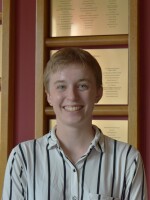
Spokane author Leyna Krow won the Washington State Book Award in the fiction category last week. Her 2025 book “Sinkhole, and Other Inexplicable Voids” is a collection of speculative stories about a changing climate.
Spokane Public Radio's Audrey Nelson sat down with Krow to learn more about her work.
The following interview has been edited for length and clarity.
AUDREY NELSON: I wanted to start with congratulations on your win.
LEYNA KROW: Oh, thank you so much.
AN: Tell me about the significance of the local award and what that means to you.
LK: Yeah, so, the book is very much set here in the Inland Northwest. There are just a couple of stories that are other places, and even those are, like, Northern California and Seattle. I'm really a Northwest person. I've been here for most of my adult life. And so, you know, writing about this place, I feel like — it's not that I don't care if people in other parts of the country read my book or have a reaction to it. I want that, too. But I feel like I'm a Northwest writer, and the audience that I care most about is first and foremost just the community that I'm in, but then also this region.
AN: So let’s talk about the book itself. I’d maybe describe it as magical realism adjacent, though I've seen other people use science fiction. What terms do you use to describe your own short story collection?
LK: Yeah, I think both of those terms apply. I kind of like the term "fabulism," because I think it's a bigger umbrella of just, like, weirdness.
Because some of the stories are — they're realism, but they're just strange. Or they're kind of predictive — they're cli-fi [climate fiction], some of them are sci-fi, some do feel very magical. And they're all kind of jammed in there together.
AN: Obviously, the central theme of this book is kind of climate fear, climate anxiety. One of the main things that happens is that there's this giant mudslide on Mount Rainier. It causes people to — survivors to kind of evacuate out to Spokane, to the Inland Northwest. It was very striking reading this after the wildfires this summer, in particular. And I'm wondering how you are thinking about your own book differently after those wildfires.
LK: Yeah, that sort of centerpiece story with the mudslide... I thought I was — when I was writing that, I thought I was making up a disaster. Like, I was trying to marry essentially two things that are real, which is outburst flooding from glaciers and lahars, which are actually caused by volcanoes. And I was like, what if I jammed this together?
And I knew that outburst flooding can be large. But then what happened in Nepal this summer is at a scale that it really hasn't occurred at before. And I was like, “This isn't—” Like, I thought I was making something up. And then something very close to it happened. And so it's — really, it's upsetting.
But the reason I wrote those stories to begin with was because I was upset. Like, these are things that I was thinking a lot about and was fearful of.
And I was like — I wanted to put that anxiety onto the page. And then, you know, it really just compounds those feelings to have everybody else sort of feeling the same way.
AN: In “Sinkhole,” a number of characters consider at various times what their role is in relation to these disasters and preventing them and fighting climate change. Has that come from your own life? Have you struggled with those thoughts and decisions yourself?
LK: Absolutely, yeah.
It's something that I think a lot about, is: When we are confronted with something that seems dire, how do we respond to it? And in the book, a number of the stories center around a family who are grappling with that. As the world changes, are you obligated to change your life with it? Or is it the right thing to lead the life you were planning to lead and do the good that you were planning to do outside of that?
I don't know the answer.
AN: What do you want people to take away from reading “Sinkhole”?
LK: That they feel seen in their own concerns. If you experience the world around you the way I experience the world around me, and you read this book, I hope there's something that feels seen and known and resonant.
I think that it sits most cleanly with women who have young children, because so much of the book is about motherhood and parenting and caring for people at different stages of life. But I hope there's a little something for everybody.
AN: Is there anything else you want to tell me? Anything I didn't ask? Anything that feels relevant?
LK: Only just that — you know, we were talking about the joy of winning regional awards. And I think for me, too, so much of that joy comes from being a part of the literary and arts community here in Spokane. I write alone in my house, people read alone in their houses, but there's all this stuff that happens in between that that sort of makes this a community activity.
And I'm just so, so, so grateful to be a part of that here in Spokane, because it would be such a lonely pursuit otherwise.
AN: Leyna, thank you so much.
LK: Thank you.